Showing posts with label utopia. Show all posts

Wednesday, November 14, 2018

Research update, week of Nov 12, 2o18


So, what am I working on these days?
Last week I finished extracting the people & communities (and a few other entires here and there) from the Utopia & Utopians: An Historical Dictionary (Trahair) and The A to Z of Utopianism (Morris & Kross) into my Heurist database. This took me about a month. It included:

  • Making pages for the people 
  • Making pages for the communities
  • Making pages for the philosophies/religions, organizations, etc
  • Making pages for the sources
  • Creating & constantly tweaking the templates for each page, creating fields for the information I wanted to record, moving the info around the pages, making fields that connect to other pages and thus building relationships between them.
  • Copy/pasting the blurbs form each of the (e)books into the correct pages
  • Filling out the basic fields, including all the ones in relationships with other pages. 
  • Often but not always copying the pertinent lines from the dictionary blurbs into the correct field sections (i.e. “Early life” or “marriage” or “community life,” etc)


I’m pleased with how many pages I have in there now (318 communities, 411 people, 118 philosophies/religions, etc) and I ran my first network connection graphing… thing… to see how all these were connected (as this was a major reason I chose this software for my research)— and was surprised at how many entires had no connections at all, so then I spent a day or few last week going back through and checking for/adding connections— plenty more work to do there, particularly in future research in general, but I assume some from the copy/pasted blurbs that I haven’t gone through properly yet, too. 

Monday I had a combined 5 hours of bus/train/lyft commenting to get to a doctor’s appointment, and I took the book Fruitlands: The Alcott Family and Their Search for Utopia. I was trying not to mark it up too much, but I was unsuccessful. The marking is excessive— just so many things to add to the Fruitlands, Amos Bronson Alcott & Charles Lane pages, but also to the pages of so many people he’s has been in connection with so far, and I’m barely into chapter 2! 

The internet is currently still down at my house and I’m actually very much looking forward to getting it back largely so I can add some of this new information to the pages for these folks, most of who I already had, but not all! This is an actual paper book, so let’s hope I am able to moderate myself so I don’t spend a year just retyping nearly the whole thing! It’s hard to know what I’ll want to know later at this stage of my research, though, as I’m still very much in the information-collection phase, with only vague ideas of what I want to write about in the future, so I'm basically saving everything that could maybe even possibly be useful in the future.

Speaking of, maybe I should write some of that out to help me start figuring out where I’ll want to go with all this first. 

So. Topics I’m interested in writing about at the moment:

  • Women in Utopia. Individuals in particular. For how women’s-rights-centric so many of these Utopian communities were, it’s interesting just how heavily male the well known of this group skews. Certainly Marie Stevens Howland, who I started researching in particular earlier this year, before deciding to expand my research at this stage so I could have more context for her life. Charlotte Perkins Gilman as well, though she’s not really a part of this crowd— she lived in a communal home in NYC as a teenager and LOATHED it, but Its actually her work in the cooperative housekeeping movement that lead me into researching these utopian communities too. To a small extent I almost consider my utopian research as background to my future work on the cooperative housekeeping movement (of the past, and how we  should bring it back in the present/future). 
    • I’ve come across quite a few women in my research so far that there seems to be nothing (or next to it) done on them, and I would really love to flesh out some of their lives as well. 1. I want to get more of these interesting women on wikipedia, with good pages! 2. I’d like to write papers about them, get their name out to the wider Utopian Studies/American history communities 3. Wouldn’t it be nice if I could turn them into a book? Maybe if I can find some coherent strings between a few of them I could make a group biography (which I love to read) or few. 
  • Alcander Longley. I keep finding him mentioned all around, and he started 5 communities (all which failed rather quickly) in Missouri, but I haven’t found much work done on him specifically somehow. 
    • Before he started his communities he seems to have lived in/visited a few. Seems like a good story there! The reader could experience the different communities through his eyes and see how they influenced him and then watch as he kept trying, and failing, to make his own successful communities. 
  • A.J. Macdonald. I haven’t looked into this yet, but I’d be interested to see how much work has been done on him. As someone who travelled to most of the still-known communities and met all the big names, he could be a great subject for a book project…
  • Josiah Warren & Modern Times. There has certainly been work done on him, but no modern work aimed at a general audience. I have some friends who consider themselves anarchists so I think it’d be interesting to share the story of the “first American anarchist” with them. 
    • Josiah the person is very interesting. A quiet, introverted inventor, musician and publisher who lived at New Harmony and knew Robert Owen, only to turn Anarchist instead and make the nation’s first anarchist paper and a string of the first anarchist communities, utilizing his concepts of Equitable Commerce and the Time Store (which might be of interest to those who are involved with Time Banking these days, as well). Plus he’s connected with the always colorful Stephen Pearl Andrews.
  • The Women’s Commonwealth- I was shocked to find this only when combing through the utopian dictionaries. An community of women who largely all left their husbands and raised their children communally seems like a pretty notable thing, so how had I not come across it before? I just did a quick google scholar search and there are certainly some writings about it, but they’re all pretty dated. Perhaps I can bring them back into the modern Utopia discussions! They weren’t, as far as I know now, trying to make a template for the rest of society to follow as is my current definition of utopian societies, but the gender dynamics might be important enough to override that and make it worth bringing back into the discussion. 
  • Urban Utopian communities. Most were rural, and most failed because no one knew what they were doing (among other reasons, especially fire), but there were at least a few Urban experiments that didn’t rely on agriculture (like Unity House). What are the stories there? What worked/didn’t work? This could be of particular relevance to folks in modern co-housing communities. 

Now that I have the basis of my research database done (though plenty of work is needed to tidy up the pages!) I feel like I have a few options as what to do next. 
  1. Go through and tidy up the pages A-Z. Make sure the right quotes from the abstracts are in the right text boxes, make sure all the connections are there— make it generally “presentable” (though I have no intention of sharing it with anyone else anytime soon, but I do intend on using these pages to create (or flesh out) the wiki pages for those that don’t have them (or robust pages) yet. Tidying up the pages would help with that a lot
    1. After that I could actually start editing their Wiki pages. It’d be good writing practice for me, but I don’t currently know how to do all the wiki-specific coding, so that would take some time to learn, I imagine, and I’m not sure the easiest way to do that at the moment. 
  2. Add the info from the Fruitlands book, and tidy up those pages as I go. 
    1. I could then go back through and add the notes I took while reading books on Marie Stevens Howland (I still haven’t finished that one), Stephen Pearl Andrews, and Josiah Warren as well. But I’ll have to hunt those things down, as that was about 8 months and 3(!) houses ago (it’s been a rather hard year). 
    2. OR I could then just double down on reading this book & extracting all the info and work on these related pages specifically, so as to stay on a specific topic for a while. I could then focus my readings on the People/Places/Things/Ideas related to that for a while. 
  3. OR… I could finish doing the thing which I had somehow forgotten I am already in the middle of doing right now (weekends confuse me, apparently), which is to continue going through John Humphrey Noyes’s book (which is mostly work of A.J. MacDonald) and extracting the info of all the communities there into the database. 

Whoops, I can’t believe I forgot I was already doing that! SMH. Ah well. It probably won’t take but a few days, and then I’ll be at this point, anyway. 

So, what should my next steps be? (I’m writing it out in order to figure it out) Perhaps this:

  1. Finish extracting the info from the Noyes book (History of American Socialisms)
  2. Extract the info I’ve read in the Fruitlands book already, but perhaps leave it for now as a “I’m going somewhere and I need a book to read” book.
  3. Read this paper I just downloaded on my phone & extract the info: “The Woman’s Commonwealth: A Study in the Coalescence of Social Forms”
  4. Contact the writer of the 2008 Masters Thesis @ MSU, “The Communist and the Altruist: Alcander Longley’s Newspapers and Communities” and ask if I could have a copy. 

And then I can go from there!

Monday, November 5, 2018

Memoir of the Yellow Springs Community

I'm currently reading History of American Socialisms (1870), written by the leader of one of the utopian communities I research (John Humphrey Noyes, Oneida), and the book is built off of a lot of research that a man had done 10+ years prior, as he spent about a decade traveling American and visiting/making notes of various utopian communities. 

He hadn't recorded the name or date of the paper, but he had, in his notes, a newspaper article on the development of the short-lived Yellow Springs community, and Noyes included it in this book. I haven't been able to track down the paper/date either, but I thought this might be of some interest to some of my friends back home in the Dayton, Ohio area, since Yellow Springs is nearby and a super cute little hippy village everyone loves to visit, so I'm just sharing the text here. 
(Holy classism and elitism, batman! I feel like I need to put a content warning on this...)

The narrative here presented," says the unknown writer, " was prepared at the request of a minister who had looked in vain for any account of the Communities established by Robert Owen in this country. It is sim- ply what it pretends to be, reminiscences by one who, while a youth, resided with his parents as a member of the Community at Yellow Springs. For some years together since his manhood, he has been associated with several of the leading men of that experiment, and has through them been informed in relation to both its outer and inner history. The article may contain some errors, as of dates and other matters unimportant to a just view of the Community ; but the social picture will be correct. With the hope that it may convey a useful lesson, it is submitted to the reader. 
Robert Owen, the projector of the Communities at Yellow Springs, Ohio, and New Harmony, Indiana, was the owner of extensive manufactories at New Lanark, Scotland. He was a man of considerable learning, much observation, and full of the love of his fellow men ; though a disbeliever in Christianity. His skep- tical views concerning the Bible were fully announced in the celebrated debate at Cincinnati between himself and Dr. Alexander Campbell. But whatever may have been his faith, he proved his philanthropy by a long life of beneficent works. At his manufactories in Scotland he established a system based on community of labor, which was crowned with the happiest effects. But it should be remembered that Owen himself was the owner of the works, and controlled all things by a single mind. The system, therefore, was only a beneficent scheme of government by a manufacturer, for the good of himself and his operatives. 
Full of zeal for the improvement of society, Owen conceived that he had discovered the cause of most of its evils in the laws of meion et tuum ; and that a state of society where there is nothing mine or thine, would be a paradise begun. He brooded upon the idea of a Community of property, and connected it with schemes for the improvement of society, until he was ready to sacrifice his own property and devote his heart and his life to his fellow men upon this basis. Too discreet to inaugurate the new system among the poorer classes of his own country, whom he found perverted by prejudice and warped by the artificial forms of society there, he resolved to proceed to the United States, and among the comparatively unperverted people, liberal institutions and cheap lands of the West, to establish Communities, founded upon common property, social equality, and the equal value of every man's labor. 
About the year 1824 Owen arrived in Cincinnati. He brought with him a history of his labors at New Lanark ; with glowing and not unjust accounts of the beneficent effects of his efforts there. He exhibited plans for his proposed Communities here ; with model farms, gardens, vineyards, play-grounds, orchards, and all the internal and external appliances of the social paradise. At Cincinnati he soon found many congenial spirits, among the first of whom was Daniel Roe, minister of the " New Jerusalem Church," a society of the followers of Swedenborg. This society was composed of a very superior class of people. They were intelligent, liberal, generous, cultivated men and women — many of them wealthy and highly educated. They were apparently the best possible material to organize and sustain a Community, such as Owen proposed. Mr Roe and many of his congregation became fascinated with Owen and his Communism ; and together with others in the city and elsewhere, soon organized a Community and furnished the means for purchasing an appropriate site for its location. In the meantime Owen proceeded to Harmony, and, with others, purchased that place, with all its buildings, vineyards, and lands, from Rapp, who emigrated to Pennsylvania and established his people at Economy. It will only be added of Owen, that after having seen the New Harmonians fairly established, he returned to Scotland. 
After careful consultation and selection, it was decided by the Cincinnati Community to purchase a domain at Yellow Springs, about seventy-five miles north of the city, [now the site of Antioch College] as the most eligible place for their purpose. It was really one of the most delightful regions in the whole West, and well worthy the residence of a people who had resolved to make many sacrifices for what they honestly believed to be a great social and moral reformation.  
The Community, as finally organized consisted of seventy-five or one hundred families ; and included professional men, teachers, merchants, mechanics, farmers, and a few common laborers. Its economy was nearly as follows :  
The property was held in trust forever, in behalf of the members of the Community, by the original purchasers, and their chosen successors, to be designated from time to time by the voice of the Community. All additional property thereafter to be acquired, by labor, purchase, or otherwise, was to be added to the common stock, for the benefit of each and all. Schools were to be established, to teach all things useful (except religion). Opinion upon all subjects was free ; and the present good of the whole Community was the standard of morals. The Sabbath was a day of rest and recreation, to be improved by walks, rides, plays, and pleasing exercises ; and by public lectures. Dancing was instituted as a most valuable means of physical and social culture ; and the ten-pin alley and other sources of amusement were open to all.  
But although Christianity was wholly ignored in the system, there was no free-loveism or other looseness of morals allowed. In short, this Community began its career under the most favorable auspices ; and if any men and women in the world could have succeeded, these should have done so. How they did succeed, and how they did not, will now be shown.  
 For the first few weeks, all entered into the new system with a will. Service was the order of the day. Men who seldom or never before labored with their hands, devoted themselves to agriculture and the mechanic arts, with a zeal which was at least commendable, though not always according to knowledge. Ministers of the gospel guided the plough ; called the swine to their corn, instead of sinners to repentance ; and let patience have her perfect work over an unruly yoke of oxen. Merchants exchanged the yard-stick for the rake or pitch-fork. All appeared to labor cheerfully for the common weal. Among the women there was even more apparent self-sacrifice. Ladies who had seldom seen the inside of their own kitchens, went into that of the common eating-house (formerly a hotel), and made themselves useful among pots and kettles : and refined young ladies, who had all their lives been waited upon, took their turns in waiting upon others at the table. And several times a week all parties who chose mingled in the social dance, in the great dining-hall. 
But notwithstanding the apparent heartiness and cordiality of this auspicious opening, it was in the social atmosphere of the Community that the first cloud arose. Self-love was a spirit which would not be exorcised. It whispered to the lowly maidens, whose former position in society had cultivated the spirit of meekness — " You are as good as the formerly rich and fortunate ; insist upon your equality." It reminded the favorites of for- mer society of their lost superiority ; and in spite of all rules, tinctured their words and actions with the love of self Similar thoughts and feelings soon arose among the men ; and though not so soon exhibited, they were none the less deep and strong. It is unnecessary to descend to details : suffice it to say, that at the end of three months — three months ! — the leading minds in the Community were compelled to acknowledge to each other that the social life of the Community could not be bounded by a single circle. They therefore acquiesced, but reluctantly, in its division into many little circles. Still they hoped, and many of them no doubt believed, that though social equality was a failure, community of property was not. But whether the law of mine and thine is natural or incidental in human character, it soon began to develop its sway. The industrious, the skillful and the strong, saw the products of their labor enjoyed by the indolent, the unskilled, and the improvident ; and self-love rose against benevolence. A band of musicians insisted that their brassy harmony was as necessary to the common happiness as bread and meat ; and declined to enter the harvest field or the work-shop. A lecturer upon natural science insisted upon talking only, while others worked. Mechanics, whose day's labor brought two dollars into the common stock, in- sisted that they should, in justice, work only half as long as the agriculturist, whose day's work brought but one.  
For a while, of course, these jealousies were only felt ; but they soon began to be spoken also. It was useless to remind all parties that the common labor of all ministered to the prosperity of the Community. Individual happiness was the law of nature, and it could not be obliterated ; and before a single year had passed, this law had scattered the members of that society, which had come together so earnestly and under such favorable circumstances, back into the selfish world from which they came. 
The writer of this sketch has since heard the history of that eventful year reviewed with honesty and earnestness by the best men and most intelligent parties of that unfortunate social experiment. They admitted the favorable circumstances which surrounded its commencement ; the intelligence, devotion, and earnestness which were brought to the cause by its projectors ; and its final, total failure. And they rested ever after in the behef that man, though disposed to philanthropy, is essentially selfish ; and that a community of social equality and common property is impossible. 

Saturday, October 20, 2018

What is a Heurist Database? [Using a Heurist Database Part 1]

Earlier this year, before I decided to give up finding a digital solution to my note-taking problem (after trying many things, like a personal wiki and scrivener), I also found this really promising ~thing~ called Heurist. I tried it for a day or so, but was overwhelmed and confused by it (despite great and super quick response to the one email I sent the Heurist folks!) and, since I was without my ADHD meds at the time (and thus was not capable of thinking very well for any extended period of time), I just gave up, and switched to notecards.

Now that I'm back on my meds consistantly again, earlier this month I suddenly got the urge to give this program another try, and I am SO glad I did!
I tweeted the above this morning and it made me realize that I haven't posted about my current database project over here yet! So, I'm going to try to explain what I'm doing and how I'm doing it.

It's been a bunch of trial and error, and my Dr. Computer Scientist boyfriend helped me a little but I've finally gotten the hang of the program (I think?) and so I want to share how great it can be, along with some tips for how to set it up, in case anyone else is googling desperately to find a little guidance on this like I was. I still have a LOT to learn about this program's capabilities, but at least I'm feeling confident enough about the basics to share!

So, Heurist is a free data management system that researchers can use to manage, analyze & present their data, based out of the University of Sydney.


I am currently using it to keep track of all the utopian/intentional communities in the US (and some outside of it) before WWI, as well as all the people I can find involved in these experiments and the utopian/etc community in general.

Before this I had been working within a personal research wiki, but I felt the need to write coherently in full sentences on each page if I added anything, which slowed down my research and threw me out of my "groove" while I was researching.

A thing I like about the Heurist system is that I have been able to add a lot of fields where I can just plug in the info/ copy/paste a quote and the citation and then keep going. It helps me stay in the flow when I'm working, which is really important for me. I can go and turn them into proper sentences/writing later.


Heurist also allows me to link various records together with specified relationships, including those that have inverse relationships.


I really like that I don't have to constantly be compiling lists of, say, every Fourierist community, because it happens automatically as I create pages for each community. 

Right now I have the following record types (some came with the program and I don't need/know how to get rid of, like for the "digital media items"


I mostly use the record types:
  • Person
  • Community
  • Organization
  • Philosophy(/Religion)
  • Historic Publications
  • Utopian Works
  • Misc/Other
Each record type has it's own template, thought it's rather hard to get a good screencap of, but here are just basic examples of the different templates for Person, Community, Philosophy and Historic Publication as of today:


Every template is definitely a work in progress. I make tweaks and changes to them every day in order to record more information or to be easier to navigate/add info to, etc.

I will make more posts in the future about different aspects of this program as I figure it all out. I'm finding it to be a really, really great for my current project!

Thursday, February 8, 2018

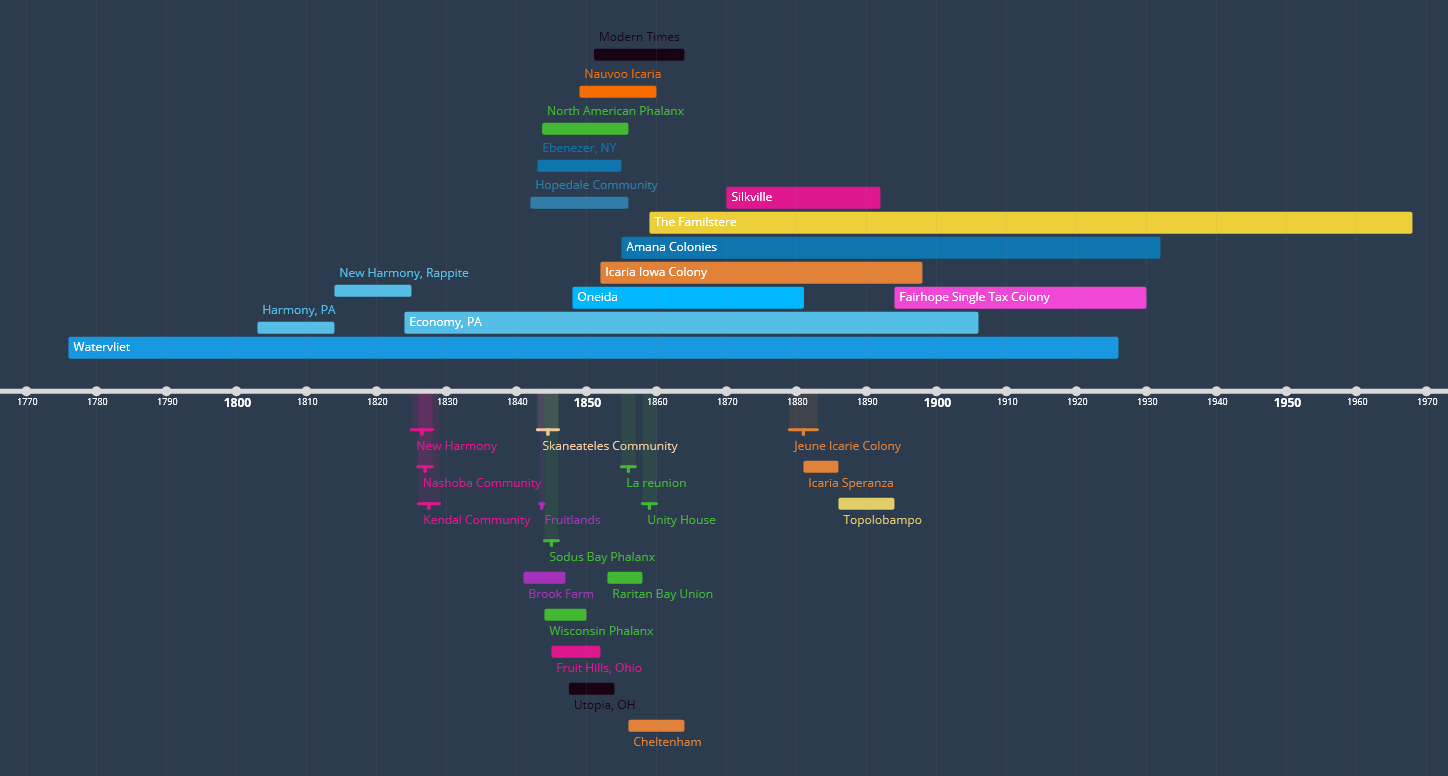
Research Tool: Time.Graphics!

My current research involves not only a whole bunch of short-lived utopian communities spread across ~100 years, but also a ton of not-very-extensively-studied individuals from the same time period.

So, I have a lot of dates to deal with, and a lot of conflicting dates to try to make sense of.

After first trying to learn how to make a graphic timeline on my new Wiki (confusing, and definitely not good for a ton of info), I gave up and went hunting for a free site that would let me visualize (& color code!) the information in a useful way.

ENTER: time.graphics! (who knew .graphics was a TLD/domain ending??)

I'm quite impressed with it so far, particularly as a free site. Being able to see all the communities I'm looking at in this way has been super helpful in understanding the context of everything I'm researching.


I also have a similar timeline with the lives of each person I'm looking at, and I'm starting to build individual timelines for each person as well. It's helped me catch a number of date contradictions from my sources!


There are a lot of features of this particular site that I haven't used, like the integration into Youtube, Google Calendar/Spreadsheet/Analytics/Maps and other things, so I can't really speak to those, but they're there!

That's it, really. I just wanted to share this since I've been finding it so useful!

Saturday, January 20, 2018

My Personal Research Wiki.... IT IS BORN!!~

When I first started on my #homegradschooling journey, I remember coming across an article by a researcher (which for the life of me I can NOT find again), explaining why he loves using a personal wiki for his research, and he linked to his own. I loved the idea, but at the time I couldn't figure out how to use it for my own work.

This week, I realized that with my current research, a Wiki is a perfect way to organize the notes for my current research. So, I set out to build one!

 And it took me A. WHILE. (hours. Miserable, miserable hours!) to figure out how to make one (since I do not currently have webspace to simply host my own via MediaWiki). There was much googling, and much registering for sites that I poked around and now will probably never go back to, such as:

  • Referata (Didn't have the infobox capability I needed)
  • WikiSpaces (ditto above, also only was able to get a free wiki because I'm a teacher)
  • ZohoWiki (Did allow for private wikis, but I don't think infoboxes)
  • wiki-site.com -- I still am not sure if this one is even legit or not. Something seemed fishy for some reason, and I think it also didn't do infoboxes, so I didn't get much past registration.
But in the end, I went with the one I had actually heard of before, but never considered it as a possibility:


I love it because:
  • It allows Infoboxes!
  • It's SO EASY to build infoboxes!
  • It allows templates! Both *for* infoboxes, and for all aspects of each page!
  • It's super easy to cite my sources 
  • Other than the rather excessive pictoral links to other wikis on the bottom of the screen, it's by far the most attractive site of any other wiki I've ever seen.
It is, of course, not perfect.
  • I wish it was easier to cite different pages from the same source without making totally new entries
  • I wish it were easy to put a map into the infoboxes without having to screengrab/find/make a map elsewhere and then just put it in as an image.
  • I wish I could make it private or members-only
But overall, I love it. 

Wiki advertises itself as a fandom wiki host/database, and while it is definitely that, it also invites personal Wikis, too. Best of all, not only does it ACTUALLY ALLOW INFOBOXES--- it has DRAG AND DROP Infobox builders!! I am so very grateful for not having to spend a ton of time trying to learn how to code stuff like that like you do on other wiki platforms. 

So beautiful ;__;

And I am nerding out to an incredible level about this so far. I have never before been so excited to type up notes and quotes! But seeing all this information coming together from all my disparate sources (I still don't know how the heck to organize paper research notes) is kinda thrilling, tbh. Especially since I really am finding so much more information on some of these people than seems to have been found and gathered by a single writer before me. Especially with Marie Stevens Case Howland, it feels like I'm the first person to ever see *all* of her life, and in context before. There's definitely something special about that for history lovers like myself.

I'm not sure if I'll ever show my research on this wiki (though when I'm done I'll definitely be transferring most of the information onto Wikipedia itself), but here, check out the size differences between Marie's Wikipedia page (left) and her barely half-done page on my wiki (right):


BAM. And actually I didn't even have any notes on Marie yet, but I was practicing with my wiki templates and just started working on her because one of my books was open to the chapter on her, and so then I went from there. And I still have managed this much so far, and I'm super excited about how it's turning out. I've been working on some other pages, including those for things I did have some notes on, and they're, obviously, even longer.


I spend so much time reading books and taking notes in pages that end up massively disorganized if not all together lost (ADHD will do that..), that my excitement is probably stemming from the fact that for once, the work I've been doing is VISUALIZED (and this is a big and important thing for ADHDers, for reasons I don't have time to explain atm). Suddenly, especially as an independent researcher, I feel SO much less like I've just been wasting time and accomplishing nothing but reading. I finally feel like the thing which in my head has been my project, can actually be recognized as "A PROJECT!" by others. My boyfriend is a fancy Ph.D. man, and even he is suddenly impressed. Feels good! 

But, I will tell you what. In all of my 30 years, I'm pretty sure that time has NEVER gone faster than it does when I'm excitedly working on this project. "i'm just going to work on this for a couple hour---OH NO HOW IS IT DINNER TIME ALREADY??!?!"

And honestly, that feels pretty good too. :)