Showing posts with label how to research. Show all posts

Monday, May 13, 2019

My Current Note Taking Routine

I haven't posted in a while because my history research has been put on hold for another project. I'm currently building a website for a future-non-profit I'm building, called Executive Dysfunction Research and Advocacy (Facebook, Facebook Group, Twitter). Basically for the last 5 and a half months I've been neck deep in research papers about Executive Functions, and taking infinite notes and doing a bunch of writing. And someone in a different Facebook group (Ologies Podcast) today asked folks for academic writing advice. I started to answer it over there, until I realized that I should probably just turn it into a proper post here. It took me a couple months to develop this system, but it seems to be working well for me now!

First off, I put the paper into Mendeley and I have been using Microsoft OneNote to take my notes. I have Mendeley downloaded on both my windows computer & my boyfriends Macbook which I occasionally borrow, and I have OneNote downloaded on my desktop, and use it via the browser when I'm on on the Macbook, so I can work from either device, which is nice!


I have different sections for the different executive functions (EFs), and then within each section, I have notes for each source, and I also do my writing drafting in there too.

To be honest, most of my notes at this stage is just me copy/pasting parts I think I may reference or quote later, and putting it into OneNote. I try to bold the parts that will help me quickly see where I should put that bit of text in my note outline later.

After MONTHS of dealing with some papers being horribly formatted so that when I copy/pasted text it included excessive and nonsensical line breaks. For a long time I was using Notepad++. When I pasted something and it looked like that, I would then cut it again, then paste it into Notepad++, then selected all, then ctrl + J to remove the line breaks, then I'd paste it back into OneNote. That's incredibly tedious though, and just last week I found something else instead!

Now, I've installed PDF Copy Paster, and instead of reading within Mendeley itself, I just right click a paper and select "Open File Externally." That opens the pdf with Adobe Reader. Then, when I copy/paste, all the line breaks are AUTOMAGICALLY removed! So, that's a nice time saver. But I still have an unbelievable amount of ex- essive hyph- enizations like this that dr- ive me ban- nanas, but since I don't feel like adding another step to put the text into Word or something and doing a search & replace (does that work if you just want to delete a hyphen and the space after it?), I just suffer with it for now. (And I do mean suffer. UGH the red squiggles make it even worse!)

Anyway, the next step involves another new find of mine, Dynalist. I have folders for each EF, and then a page for each eventual page on the website. I can use bold & check boxes


On each page I start with a general structural outline for the page. Then, after I read each paper (or sometimes after a few), I then put Dynalist on one half of my screen and OneNote on the other, and start copying the text into the outline. I put it in the correct section, and as I find patterns in the notes, or new ideas, I will add new sections to the appropriate pages as needed. I will group quotes into sub-sections based on theme/idea just to make it easier to reference when i get to writing, and to make the notes better managable (as you can collapse sections). So the sub-sub-sections don't necessarily mean they'll have their own bit/section in the writing, it just brings together the bits about the same thing from various sources so I can choose the best quote or better reference the idea when I mention it in the writing (if I do at all).


I don't know if this is the most efficient method or not, but currently, before I start copying my notes over, I type & copy to my clipboard " (1st Author's Surname) ". Then, after I copy the text into the note outline (ctrl + V), I hit (ctrl + shift + v) and then hit the number the author is on (for me it's usually 2). I use ClipX clipboard manager so that I can have multiple things in my clipboard at once. But this way, even if I move the notes around, I never lose the source.


Then, as I write, I keep my screen split between Dynalist & OneNote, and I work from my notes as I go, checking off the ideas/quotes I use. For me and how my brain works, this is working quite well for me so far! If my system changes in the future, I will update here.

Oh and one last thing! I also have been using Focus To-Do as my pomodoro timer. It helps me keep track of the passing of time and thus helps keep me from spending too much time on certain tasks, and reminds me to take small breaks throughout the day so that I don't burn myself out.

Friday, November 9, 2018

Histories of the Unexpected: How to Be A Historian (Podcast)!

This has been a good week for me and how-to-do-history podcasts! Not only did I start listening to the Doing History: On Biography series on Ben Franklin's World, but I also found a new podcast all together, Histories of the Unexpected, with BBC History Presenter Dr. Sam Willis & Professor James Daybell. 


The podcast itself is an ADHD History Nerd's absolute dream, with episodes having the sense of a very well-informed free-association chat on themes such as "The Lean" or "Dust." And last year, they did a mini-series on How to Be a Historian, which is, obviously, exactly the kind of podcasts/resources I love coming across! 

EPISODE 41: HOW TO BE A HISTORIAN – EPISODE 1 (This episode goes into what each of the hosts do as historians)
EPISIDE 49: HOW TO BE A HISTORIAN – EPISODE 2  (How they became historians)
EPISODE 50: HOW TO BE A HISTORIAN – EPISODE 3 (How to get your kids into history)
EPISODE 56: HOW TO BE A HISTORIAN – EPISODE 5 (How to choose a subject and start on research)

Episodes 1, 2, & 5 are great insight to the backgrounds, professional lives, and methods of working of two very different types of historians, and I found it to be an excellent listen!

Wednesday, November 7, 2018

Ben Franklin's World: Doing History: On Biography! (Podcast Series!)

It looks like it's been a few years since I've mentioned the excellent Doing History series on the Ben Franklin's World history podcast, but the host Liz Covart is currently doing season 3: On  Biography, and I am super excited!


It's exciting for me because what little information I can find online that is helpful to me as a self-trained historian is pretty much never about biography, which is probably what most of my work will be (biographies of people and also of communities). I have searched quite a bit online for specific How-To-Do-Biography information, advice, resources, etc, but have always come up empty handed. So I admit to doing so happy flailing when I looked at my History "channel" on my Stitcher (podcast) app and saw see that there was not only more Doing History episodes, but it was exactly what I most wanted to see! So, thank you Liz & the Omohundro Institute! 

Oh, oh, oh. And! Not only does this series exist, which is great, but also the first episode (Episode 209: Considering Biography) even features one of my all-time favorite biographers, the amazing Professor of History & Law at Harvard, Annette Gordon-Reed. She wrote The Hemingses of Monticello: An American Family which I listened to while driving across country last year and it just blew me away. The depth of the research, and the way she was able to return to Sally Hemmings the personhood and agency that  has been denied to her in every other work I've read, and while still portraying Jefferson as a real human, without making excuses for him but also without turning him into a caricature villain (I certainly do consider all slave owners villains, but I find it very useful to learn about him in all his complexities and contradictions.)

The series isn't completed yet, but I'll come back and edit in the 4th episode next week. As of now the episodes are:

Episode 209: Considering Biography
Episode 210: Considering John Marshall, Part 1
Episode 211: Considering John Marshall, Part 2


I highly recommend checking them out! :)

Sunday, November 4, 2018

Archive.org !!!! Treasure trove of old texts to borrow!

I know I've landed on archive.org's site before, on occasion google has lead me there for a text of an old book/document on there.. but for some reason it's never been a source I regularly check/use.

WHY, THOUGH?

Today for the first time I was lead there to a page that would let me borrow an old, niche-as-heck book that my local libraries don't have and that I was about to have to buy off of AbeBooks.com.

After a couple clicks, LOOK WHAT I FOUND!


These are all borrowable books!

Books I don't have to buy!

Many books I didn't even know existed!

I was so excited! So overwhelmed!

I decided to make some new collections on Wakelet.com to keep track of the stuff I want to read. I made Utopian People, Utopia (General), and Community Biographies.


Hoepfully this will help me from getting too overwhelmed! I'm super excited for all these new books and just wanted to make this post real quick to make note of this exciting new discovery, which probably everyone else already knows about!

Saturday, October 20, 2018

What is a Heurist Database? [Using a Heurist Database Part 1]

Earlier this year, before I decided to give up finding a digital solution to my note-taking problem (after trying many things, like a personal wiki and scrivener), I also found this really promising ~thing~ called Heurist. I tried it for a day or so, but was overwhelmed and confused by it (despite great and super quick response to the one email I sent the Heurist folks!) and, since I was without my ADHD meds at the time (and thus was not capable of thinking very well for any extended period of time), I just gave up, and switched to notecards.

Now that I'm back on my meds consistantly again, earlier this month I suddenly got the urge to give this program another try, and I am SO glad I did!
I tweeted the above this morning and it made me realize that I haven't posted about my current database project over here yet! So, I'm going to try to explain what I'm doing and how I'm doing it.

It's been a bunch of trial and error, and my Dr. Computer Scientist boyfriend helped me a little but I've finally gotten the hang of the program (I think?) and so I want to share how great it can be, along with some tips for how to set it up, in case anyone else is googling desperately to find a little guidance on this like I was. I still have a LOT to learn about this program's capabilities, but at least I'm feeling confident enough about the basics to share!

So, Heurist is a free data management system that researchers can use to manage, analyze & present their data, based out of the University of Sydney.


I am currently using it to keep track of all the utopian/intentional communities in the US (and some outside of it) before WWI, as well as all the people I can find involved in these experiments and the utopian/etc community in general.

Before this I had been working within a personal research wiki, but I felt the need to write coherently in full sentences on each page if I added anything, which slowed down my research and threw me out of my "groove" while I was researching.

A thing I like about the Heurist system is that I have been able to add a lot of fields where I can just plug in the info/ copy/paste a quote and the citation and then keep going. It helps me stay in the flow when I'm working, which is really important for me. I can go and turn them into proper sentences/writing later.


Heurist also allows me to link various records together with specified relationships, including those that have inverse relationships.


I really like that I don't have to constantly be compiling lists of, say, every Fourierist community, because it happens automatically as I create pages for each community. 

Right now I have the following record types (some came with the program and I don't need/know how to get rid of, like for the "digital media items"


I mostly use the record types:
  • Person
  • Community
  • Organization
  • Philosophy(/Religion)
  • Historic Publications
  • Utopian Works
  • Misc/Other
Each record type has it's own template, thought it's rather hard to get a good screencap of, but here are just basic examples of the different templates for Person, Community, Philosophy and Historic Publication as of today:


Every template is definitely a work in progress. I make tweaks and changes to them every day in order to record more information or to be easier to navigate/add info to, etc.

I will make more posts in the future about different aspects of this program as I figure it all out. I'm finding it to be a really, really great for my current project!

Friday, August 17, 2018

Summer's over! Time to get back to research!

Now that my son is headed back to school, I have time once again to get back into my research! I moved at the beginning of summer, and I'm about to move again, so I'm reconfiguring my research set up and habits again.

This spring, I wrote out a LOT of note cards. I stopped because my EDS/HSD (a connective tissue condition) means that all the writing is killer on my hands, especially my index fingers, as the pressure from gripping the pen makes the joint hyperextend excessively. 

I tried the PenAgain, which a lot of fellow EDSers use, and was super pleased at first, but after just a couple weeks I realized that:

  1. They run out of ink SO QUICKLY
  2. It's better than regular pens, but still makes my fingers/hands cramp
  3. I take way too many notes (but i'm also probably not going to stop)
  4. Sometimes I just really NEED to have multiple copies of the same card to put in different places in my organizational system, but neither my fingers nor my attention span play nicely with that need. 

So, what I really think I need, is a way to print out note cards.

A LOT of them. 

So this morning I've been trying to figure out how I can do just that. 

Articles like this one taught me that, hey! Sometimes regular printers can print on note cards! Including mine! HOORAY!

But, then it says how to print out of Word, which I do not have a functioning copy of. So, after looking up some free word processing software options, I downloaded WPS Office. It does have a page layout template for notecards, but then I realized it doesn't have a citation plugin for my reference manager, Mendeley. So then I downloaded LibreOffice, which is Mendeley compatible... but then I couldn't figure out how to format it to index card size! So, back to WPS Writer I went.

Oh, and somewhere in there I downloaded Zotero and started trying that out, too, since Mendeley wasn't giving me any good options of how to cite The Great Courses lecture I'm currently listening to. Maybe my next post will be about how I manage to get this system working!

Tuesday, March 13, 2018

On Writing EVERY Day (Advice from Twitter)

As a person who follows hundreds of academics across social media, I very frequently see reminders that we should all be writing something every day. Indeed, that was the main reason for making this blog, so I could practice stringing sentences together at least several times a week. But, as anyone who has seen this blog can see, I haven't actually been writing about what I'm researching, only how I'm researching.

The problem is, I haven't known what to write about my topic. I'm researching a number of rather obscure people, groups, and communities, so I don't feel like I have enough information about anything or anyone to write about in any way worth my time quite yet. I did start an annotated bibliography recently, but other than that, I haven't really been "writing" anything yet. Outside of the hundreds of index cards I've been furiously scribbling my notes onto for the past week, that is.

So, during a work break this morning, I shot off the following tweet:
Now usually, when I ask questions on #twitterstorians or #AcademicTwitter, I almost never get a reply. But, by some magic (and kind RTs from @AcademicChatter, @raulpacheco, & @erin_bartram!) I actually did get a slew of them this morning, and I think they're worth sharing here, too.


There were also a number of tweets in support of note-taking itself being considered academic writing:


And I think @HthrLynnJ's points are especially important and worth highlighting:


Friday, March 9, 2018

#AcWriChat 3.9.18 - Building a network through blogs & social media

I just happened to catch my first #AcWriChat on twitter this morning! Today's chat was about 'Building a network through blogs and social media.'

I'm not really in a 'build a network' stage yet, but I'm glad I attended. @TextandAcademicAuthors shared a lot of great resources, including lists which included some academic bloggers I wasn't following yet! (I love finding new blogs to follow!)

I'm now going through the #AcWriChat archives and I wanted to make note (/link) of some of the other chats that I'm finding useful:

#AcWriChat 12/15/2017 - Imagining
This #AcWriChat event focused on imagining your writing project: thinking about the writing project, reflecting on insights, and looking for ways to interpret and explain findings
 #AcWriChat 12/29/2017 - Organizing (part 1)

This week we will begin to look at the organization of a writing project, specifically gathering ideas from existing literature, prioritizing content for inclusion in the new work, and outlining the thematic structure of the manuscript.
There are more chat archives over at: TAA #AcWriChat re-caps on getting organized, writing productivity, and more!


Thursday, February 22, 2018

Okay, but what the heck do I do with all these research notes?!?!

- me, for months.

I've tried a wiki, which, though it doesn't quite work for the note taking/collecting stage that I'm currently struggling with, I do generally like and will still probably be using further down my workflow pipeline (that is, unless I find a Heurist database more helpful than a straight up wiki for that stage, as this week I've been experimenting with that).

After realizing that it wasn't quite the thing for this stage of the research, I shifted over to Scrivener, where I first basically copied the format of a wiki page with each section getting it's own text (page/note), but allowing for more unstructured info and quotes, etc. But that still wasn't quite what I needed (duh, I say retrospectively.)

Then I found the idea of conceptual matrices (yes I spelled it wrong in Scrivener) that seem to work so well for things that aren't biographical research... I tried those, continuously having to break them down so each page wasn't getting so unwieldy, and so here I am now, with this total mess:


#REGRET


So, I've spent waaaay too much time the last couple of days trying to figure out what to do, looking into various possibilities (I do NOT understand how people use Evernote for this, I would simply DIE of overwhelm) (and TiddlyWiki sounded promising, but was super confusing and I gave up on that, too.)

Sooooo, what did I end up with after all this searching?

Why, the very system I was trying so hard to find a digital alternative for, of course!

Index Cards.


Credit goes to Ryan Holiday's Thought Catalog article The Notecard System: The Key For Remembering, Organizing And Using Everything You Read, in which he explains that index cards were:
"... responsible for helping me publish three books in three years, (along with other books I’ve had the privilege of contributing to), write countless articles published in newspapers and websites, send out my reading recommendations every month, and make all sorts of other work and personal successes possible."
Uh, yes please. I would like to have anything approaching that level of productivity!
Okay, okay. I should use the notecard system. But of course I then spent half a day trying to find an explicitly digital-index-card system (Scrivener's not counting bc I need a bazillion cards) because, trees! Hand cramping! Supply costs! Travel! Etc!

NoodleTools, though aimed at k-12 students, seemed pretty close, but then I just gave up. I don't want all my notes in such a closed system, anyway. I should just use the actual, physical cards.

So, I can't afford a printer to just print & paste things onto the cards, and my hand is already aching at the thought of what's to come, but I  know darn well that this is the best possible system that currently exists that works best for my brain.

My brain is weird, you see (I have severe ADHD..) and I really do work better with physical copies of things, though my millennial self generally prefers that which is digital and techie. But, ADHD brains in particular really do need things, especially information, to be "externalized" and physically manipulatable (our working memory is crap).

In fact, I thought to write this post after reading this article by fellow ADHDer Aimée Morrison
For me, paper is visible in very important ways: scale, scope, the gist. How much progress I’m making, how much I have left. Where the holes are, sometimes literally. Paper is a massive memory aid, an externalization of my working memory, all the more crucial the larger or more complex a task becomes. Colour coded sticky notes and pens and paper clips and highlighting–I scan it from above and easily zoom down to what I need.

For me, electronic text is inscrutable and frustrating, like trying to watch a movie in the front row of the cinema with a pinhole camera: I can’t get any sense of scale or make sense of anything, and I get dizzy, to boot. There’s no way I could follow any kind of narrative and it’s a challenge not to barf. All the blue light, not enough screen, too many tabs and open windows and nothing findable. Stress nap!
I found this article to be super validating for me, especially since a few days ago I had already gone ahead and ordered some supplies! Thanks, Aimée! :)


Woops this post turned out way longer than intended, but I realized I should make a record of all the things I looked into first, so I don't forget and do this whole thing over again next year!

Tuesday, February 20, 2018

Annotated Bibliography, Chicago Style

when it includes manuscript sources, archival collections, or other materials that do not fit into a straight alphabetical listSo yesterday I took some notes on how to research better, and one of the sources I used was “The Annotated Bibliography Exercise” by Dr. Steven D. Krause from The Process of Research Writing.

It made good points about the usefulness of making an annotated bib. so I've decided to start gathering what sources I've used so far into a few of them (I have a few concurrent projects under the same general umbrella of utopia/etc). I'm going to have them here on the blog (on pages, instead of posts) but may not share them for a while.

But, before I start on that, I need to check out the specifics of how to do this in the Chicago Style. So, I figured I'd make a post on this, too, at the least for my own easy reference.

Annotated Bibliography in Chicago Style

Since I cannot afford access to the full Chicago style manual, I'm using these pages for reference:

According to these sites, an annotated bibliography entry done in Chicago style has:

  • one summary paragraph describing the source and it's major features
  • summaries can be descriptive or 'can evaluate the quality of scholarship in a book or article
  • Another accepted method of making an annotated bib in Chicago & Turbian style is to have the proper citation and then the next line (indented) contain a very brief descriptive phrase in brackets, i.e. (from Middlebury Libraries): " [a seminal text describing argument in nonsymbolic language]
  • The first line of each summary paragraph should be indented, but the rest of the paragraph does not need to be.
  • The first line of the entry's citation must NOT be indented ("Hanging indent"), but if it spills over into subsequent lines of text, those SHOULD be indented.
  • Text should be double-spaced, with 1" margins on all sides

.... Okay, well, the pages contradict each other on whether or not the whole summary (not just the first line) should be indented, so I went ahead and got a 30 day free trial for access to The Chicago Manual of Style Online (CMOS 17) (and... there isn't just a simple entry for how to format an annotated bibliography. ...?!?! Sigh. So, looks like I'm going to have to dig a little...

Building the entry:

  • Author's names should be listed exactly as they are in the source, excepting when:
    • there are different people using the same name & initials, a full name may be given. (15.12)
    • If multiple authors have the same first and last name, middle initials can be added to clarify if they are known (14.73)
    • A single author uses both their full name and initials in different works, the author should be listed by the same format of name for all their works (preferably the full name). (14.73)
      • If an author is well known by both their full names & with their initials, the rest of the name may be added in brackets, i.e., (R.S. Crane + R[onald] S. Crane.(14.74)
    • If an author always uses their initials, they should be listed with the initials, not their full names
  • If the author or editor is unknown:
    • Initial articles should be ignored (but included) and the entry should begin with the title. (14.79) 
    • 'Anonymous' should generally only be listed if the work was explicitly attributed to "Anonymous" (i.e. on the title page, etc) (14.79) 
    • If the author was not listed in the work but is known or guessed, the name should be included within brackets (and with a question mark when the identity is guessed but not known for certain) i.e., " [Hawkes, James?]. "  (14.79)
  • If a Pseudonym / Pen name is used:
    • Between the name and the period [pseud.] can be given. (14.80)
    • If 'widely used', the pen name is treated like real names, i.e. Mark Twain or George Eliot
    • If the real name is 'of interest to readers,' it can be included after the name (and before the period) in brackets. (14.80)
    • 'If the author's real name is better known than the pseudonym, the real name should be used. If needed, the pseudonym may be included in brackets, followed by pseud.' i.e. you could list ' Brontë, Charlotte. ' or ' Brontë, Charlotte [Currer Bell, pseud.]. ' as the author of Jane Eyre. (14.80)
  • If an author has published under different versions of their real name (as in married names, etc), a source should be listed under the name used in that work, but a cross reference note can be included, i.e. "Doniger, Wendy." and "---. See also O'Flaherty, Wendy Doniger."

Order of entries:

  • Entries should be alphabetized by the last name of the author. CMOS recommends letter-by-letter alphabetizing, but word-by-word is also acceptable. (14.65)
    • Hyphenated last names should be treated as one word, and unhypened names should be checked in reference sources, but for 'unhyphenated compound names of lesser-known persons for whom proper usage cannot be determined, use only the last element (including any particle[s])' i.e. Websters says that Ludwig Mies van der Rohe's last name is 'Mies van der Rohe', but Charlotte Perkins Gilman should be listed as Gilman  (8.6)
    • Unusual name formats:
      • Names starting with O' are treated as if there were no apostrophe (16.73)
      • Names with particles (d', di, la, van, etc) can vary. Merriam-Webster's biographical entries are authoritative for the historical figures they include. Otherwise, personal preference of the author, and cross referencing of other sources (LoC, Websters, Encyclopedias, etc) should be done and one method decided on for that particular name. (16.71)
      • Last names including Saint, San or St. should be listed as the family spells their name, but cross-referencing may be helpful (16.74)
      • Titles such as Saint or King or place identifiers ("of England") are left out. (14.83)
      • If a letter is accented, it is treated in this context as unaccented. (16.67)
    • "Authors usually should not use the 3-em dash for repeated names in their manuscripts." (i.e., using '---' in a list of bibliography entries under the same author. Some publishers/editors might use them, though. (14.67)
  • In bibliography (excluding bibs. of the works of a single author), 'titles by the same author' are usually listed alphabetically, with the initial 'the, a, or an' left out. (14.71)
  • An entry with only one name should be listed before an entry starting with the same name but also including other authors. If multiple such multi-authored entries, they should be alphabetized by the next author's last name (though only the first author's name should be inverted) (14.66)
  • If an Organization, corporation, association, etc, published something and there is no personal author listed, the group name should be listed as the author, no word inversion. (14.84)

Format:

  • In the example image of an annotated bib. entry, the first line of the citation is a "hanging indent" but ALL the rest of the text is indented. (Figure 14.10)
  • All formats of sources should be included in the same alphabetized bibliography, unless dividing it into sections would make it significantly easier for readers. Bib. lists might appropriately have divided lists when: (14.62)
    • 'it includes manuscript sources, archival collections, or other materials that do not fit into a straight alphabetical list'
    • 'readers need to see at a glance the distinction between different kinds of works—for example, in a study of one writer, between works by the writer and those about him or her'
    • 'the bibliography is intended primarily as a guide to further reading'
  • When a list is divided, 'a headnote should appear at the beginning of the bibliography, and each section should be introduced by an explanatory subhead.' Each source should only be included in ONLY one section. (14.63)

Monday, February 19, 2018

METHODS: Citing Your Sources-- Avoiding Plagiarism - Safe Practices - 2.4 Historical Methodology, saylor.org

Reading: Dr. Steven Kreis’s The History Guide: A Student’s Guide to the Study of History: I've just started working my way through Saylor.org's HIST104: Historical Methodology - The Art and Craft of the Historian, and I'm now on Unit 2: Basic Historical Research Skills. 

In lieu of me actually being in a class where things are discussed, I'll just write my thoughts about the materials here.

2.4 Producing a Finished Product

2.4.3 Citing Your Sources—Avoiding Plagiarism

Reading: Purdue University’s Online Writing Lab: Karl Stolley’s and Allen Brizee’s 
“Avoiding Plagiarism”: “Is It Plagiarism Yet?,” and “Safe Practices”
in "Is It Plagiarism Yet?" the author's reiterate that citation is needed for all words, ideas, visuals, and media that originate from any person, 'magazine, book, newspaper, song, TV program, movie, Web page, computer program, letter, advertisement, or any other medium'.
Citations are NOT needed for "common knowledge" ('folklore, common sense observations, myths, urban legends, and historical events'), 'generally-accepted facts' (including 'facts that are accepted within particular discourse communities'), your own thoughts, observations, conclusions, experiment results, or art (of any format).
According to the authors, a fact can (generally) be considered common knowledge if you can find it documented 'in at least five credible sources/' When in doubt, cite, and an editor or teacher can let you know what is superfluous.
 "Safe Practices" gives a number of suggestions of how researchers can avoid accidental plagairism down the line. This includes labeling 'someone else's words with a big Q' or use "big quotation marks." For ideas, you can label those from the source with a big S, and those from yourself with ME. And of course, always make sure the citation for your source is written with the notes.
 The author's instructions for paraphrases or summaries (whole list is a direct quotation)
  •  Use a statement that credits the source somewhere in the paraphrase or summary, e.g., According to Jonathan Kozol, ...).
  • If you're having trouble summarizing, try writing your paraphrase or summary of a text without looking at the original, relying only on your memory and notes
  • Check your paraphrase or summary against the original text; correct any errors in content accuracy, and be sure to use quotation marks to set off any exact phrases from the original text
  • Check your paraphrase or summary against sentence and paragraph structure, as copying those is also considered plagiarism.
  • Put quotation marks around any unique words or phrases that you cannot or do not want to change: e.g., "savage inequalities" exist throughout our educational system (Kozol).
 For direct quotes, the author's recommendations include keeping the 'source author's name in the same sentence as the quote,' correctly use quotation marks &/or block-text format, according to the style, and to quote only the material necessesary (both in selections & amount of text within that selection.)
Ellipsis (...) can be used to remove excess information and thus shorten the quotation, but 'terminal puncutuation' should be maintained between the ellipses. Context or other slight changes to a quote can be done with brackets ( [ ] ) but one must 'be careful not to editorialize or make any additions that skew the original meaning' 
Writers should 'proofread and cross-check' with your notes and sources' to make sure all outside words, ideas, etc are properly credited.

METHODS: Citing Your Sources-- Avoiding Plagiarism - Quoting & Paraphrasing - 2.4, Historical Methodology, saylor.org

Reading: Dr. Steven Kreis’s The History Guide: A Student’s Guide to the Study of History: I've just started working my way through Saylor.org's HIST104: Historical Methodology - The Art and Craft of the Historian, and I'm now on Unit 2: Basic Historical Research Skills. 

In lieu of me actually being in a class where things are discussed, I'll just write my thoughts about the materials here.

2.4 Producing a Finished Product

2.4.3 Citing Your Sources—Avoiding Plagiarism
Reading: Dr. Steven D. Krause’s The Process of Research Writing: 

The author says that it can be hard to 'effectively quote and paraphrase research', and that it takes practice. This chapter's goal is to introduce the reader some basic strategies. He reiterates the basic guidelines from the annotated bibliography chapter:
  • Stay neutral. Summaries should be "just the facts"
  • Don't quote the thing you're summarizing  
  • Don't cut and paste from abstracts!
"The general rule of thumb is any time you use three or more words as they appeared in the original source, you should treat it as a quote."
 Both quotes & paraphrases should:
  •  be "introduced," especially the first time a certain source is mentioned
  • 'include an explanation of why that piece of evidence is important 
  • 'include a proper citation of the source' 
 The author says that there's an art to the effective use of quotes and paraphrases. He says that it's generally best to use a quote when:
  •  The exact wording is important to your point
  • 'You want to highlight your agreement with the author's words'
  • 'You want to highlight your disagreement with the author's words'
And paraphrasing is best used when: 
  •  'There is no good reason to use a quote to refer to your evidence' (i.e. if the exact wording is not important to your point)
  •  You're explaining a particular bit of evidence in order to explain, analyze, or interpret it in detail
  • 'You need to balance a direct quote in your writing', as you need to be careful about quoting too much, as it makes your paper,etc harder and more awkward to read 
 The author gives this example as a decent way to include a quote:
'In her Pharmaceutical Executive article available through the Wilson Select Internet database, Jill Wechsler writes about one of the positive effects of advertising prescription drugs on television. “African-American physicians regard direct-to-consumer advertising of prescription medicines as one way to educate minority patients about needed treatment and healthcare options.”'
 He also includes this bad/good example of how to paraphrase (using MLA):
The next section of this chapter is on avoiding plagiarism. It tells us that plagiarism is theft, and academia has strict rules and serious punishments for those who plagiarize.
The author reminds us that not only is there purposeful plagiarism, but the biggest problem in academia is what he calls 'accidental plagiarism.' That is the 'result of improperly paraphrasing, summarizing, quoting, or citing your evidence in your academic wiring.' He created a useful example of what accidental plagairism might look like using this original exerpt:
Those who denounce cyberculture today strangely resemble those who
criticized rock music during the fifties and sixties. Rock started out as an
Anglo-American phenomenon and has become an industry. Nonetheless,
it was able to capture the hopes of young people around the world and
provided enjoyment to those of us who listened to or played rock. Sixties
pop was the conscience of one or two generations that helped bring the
war in Vietnam to a close. Obviously, neither rock nor pop has solved
global poverty or hunger. But is this a reason to be “against” them? (ix).

(Lévy, Pierre. Cyberculture. Trans. Robert Bononno. Minneapolis: U of Minnesota P, 2001.)
His example of accidental plagairism: 
The same kind of people who criticize cyberculture are the same kind of people who criticized rock and roll music back in the fifties and sixties. But both cyberculture and rock music inspire and entertain young people.
 Despite not using the exact words from the original, the author states that they 'are certainly close enough to constitute a form of plagiarism.' He points out that it's easy to change a plagiarized paragraph into an acceptable one, simply by properly citing the source. His corrected paraphrase:
Pierre Lévy suggests that the same kind of people who criticize cyberculture are the same kind of people who criticized rock and roll music back in the fifties and sixties. But both cyberculture and rock music inspire and entertain young people (ix).
 The "golden rule" to avoid plagairism is to "Always cite your sources." and when in doubt of when you should cite... "you should probably cite your source."

METHODS: Citing Your Sources-- Avoiding Plagiarism - Footnotes - 2.4, Historical Methodology, saylor.org

Reading: Dr. Steven Kreis’s The History Guide: A Student’s Guide to the Study of History: I've just started working my way through Saylor.org's HIST104: Historical Methodology - The Art and Craft of the Historian, and I'm now on Unit 2: Basic Historical Research Skills. 

In lieu of me actually being in a class where things are discussed, I'll just write my thoughts about the materials here.


2.4 Producing a Finished Product

2.4.3 Citing Your Sources—Avoiding Plagiarism

Reading: Dr. Steven Kreis’s The History Guide: A Student’s Guide to the Study of History: 
In this section, which is written specifically for students of history, explains how to properly use footnotes in a paper. Footnotes (or endnotes) MUST be used:
  • to cite every direct quote used
  • when a controversial fact or opinion is given
  • on the statements that are the main points of your paper
They can also be used: 
  •  to include your own thoughts/statements about something that doesn't fit into the outline/flow of the paper
The author points out that if you have a string of pages with few (or no) footnotes, you are probably not citing things that you should be, but also 'if you insert a footnote every other sentence, then you may be overdoing it.
A single footnote at the beginning or end of the paragraph can be used instead of a string of footnotes all citing the exact same thing, but this is acceptably ONLY 'if and only if the note refers to the information in the paragraph as a whole.'
 Footnotes should be at the end of a sentence or quote, in superscript. It is okay if two notes are needed in the same sentence, though. The appropriate style manual should be consulted for the details of how to format footnotes.

METHODS: Conducting Research and Organizing Information - Preparing to Write - 2.3, Historical Methodology, saylor.org

I've just started working my way through Saylor.org's HIST104: Historical Methodology - The Art and Craft of the Historian, and I'm now on Unit 2: Basic Historical Research Skills. 

In lieu of me actually being in a class where things are discussed, I'll just write my thoughts about the materials here.

2.3 Conducting Research and Organizing Information

2.3.5 Preparing to Write an Essay
Reading: Purdue University’s Online Writing Labs: Stacy Weida’s and Karl Stolley’s 
This page discusses the use of rhetorical elements to help orient you as you begin to write. They include the follow questions to ask yourself:
  • Who is the audience for your writing?
  • Do you think your audience is interested in the topic? Why or why not?
  • Why should your audience be interested in this topic?
  • What does your audience already know about this topic?
  • What does your audience need to know about this topic?
  • What experiences has your audience had that would influence them on this topic?
  • What do you hope the audience will gain from your text? 
 They also include a list of some of the different purposes writing can have, as it's important to know what you are trying to do before you start to write. One paper can use multiple strategies at different points.
  • Summarizing: Presenting the main points or essence of another text in a condensed form
  • Arguing/Persuading: Expressing a viewpoint on an issue or topic in an effort to convince others that your viewpoint is correct
  • Narrating: Telling a story or giving an account of events
  • Evaluating: Examining something in order to determine its value or worth based on a set of criteria.
  • Analyzing: Breaking a topic down into its component parts in order to examine the relationships between the parts.
  • Responding: Writing that is in a direct dialogue with another text.
  • Examining/Investigating: Systematically questioning a topic to discover or uncover facts that are not widely known or accepted, in a way that strives to be as neutral and objective as possible.
  • Observing: Helping the reader see and understand a person, place, object, image or event that you have directly watched or experienced through detailed sensory descriptions.
 Once a thesis has been made and the aforementioned things have been taken into consideration, the authors instruct us to "just start writing!", ignoring issues of formatting, grammar, complete sentences-- i.e., brainstorm as much as you can think of that relates to your thesis. Then you can re-read and evaluate, and cut that which doesn't fit. From there you can go on to build an outline structure for your paper.

METHODS: Conducting Research and Organizing Information - Taking Notes - 2.3, Historical Methodology, saylor.org

I've just started working my way through Saylor.org's HIST104: Historical Methodology - The Art and Craft of the Historian, and I'm now on Unit 2: Basic Historical Research Skills. 

In lieu of me actually being in a class where things are discussed, I'll just write my thoughts about the materials here.

2.3 Conducting Research and Organizing Information

2.3.4 Taking Notes on Sources
Reading: Dr. Steven Kreis’s The History Guide: A Student’s Guide to the Study of History: 
In 4.7 the author reminds us of the importance of knowing what you're looking for when you are researching when it comes to writing good notes.  
When reading material that we want to use in our research, we should make notes of what the author is trying to say, what interpretation they are pressing, what sources do they use? How is the material useful to your research? etc. 
We also must have a 'clear understanding and grasp of your topic.' I found these lines notably important: "In other words, it's not enough to say you want to write about such and such a topic. You need to ask yourself why." 
He goes on to talk about how to use quotes. Historians must use direct quotes, but also must be sure to not over-use them. With any quote you have to explain why that quote is significant/relevant, and "when in doubt, leave it out." 
An important part of being able to use quotations effectively is being able to paraphrase the arguments of the author so that it can be blended with your own. He tells us to first in our minds, then on paper, paraphrase whatever passage/section/chapter you are reading at the time. And then, 'Try to explain things in your own words first, and then retrieve a quotation or series of short quotations to give force to what you just said.' 
He also points out that if an author quotes another author, you can use that, but you need to also locate the original source (often a footnote), or, if you can't find it, to make note of that, too (often also in a footnote) 
He also details how best to use note cards to take notes.

METHODS: Conducting Research and Organizing Information - Annotated Bibliography - 2.3, Historical Methodology, saylor.org

I've just started working my way through Saylor.org's HIST104: Historical Methodology - The Art and Craft of the Historian, and I'm now on Unit 2: Basic Historical Research Skills. 

In lieu of me actually being in a class where things are discussed, I'll just write my thoughts about the materials here.

2.3 Conducting Research and Organizing Information

2.3.1 Developing an Annotated Bibliography 
Reading: Dr. Steven D. Krause’s The Process of Research Writing: 

This chapter explains what an Annotated Bibliography is (a list of sources on a particular topic with a brief summary of each that you will be "building" throughout your research), how to make one, and why it's an important thing for researchers to do (it's a system to keep track of evidence that you collect in your research).
 Annotated bib. entries have two parts: the top is the citation (which varies according to style), and the second is the summary. The summary should be 'a sentence or two' to remind you, and to show other researchers, what a certain piece of research is about. It should be neutral and devoid of personal opinions or direct quotes. It should be written to help others interested in the same topic be able to assess what sources they themselves should check out. 
The author concedes  that summaries can be hard to write, especially if the source is long and/or complicated, but these guidelines should be kept in mind while writing them. He also warns against cutting & pasting lines from abstracts into the summary. That is both plagerism, and defeats one of the purposes of the annotated bib-- to help the researcher understand and explain what they are reading and how it may fit in to the overall project.
Two of the examples the author gives are:

Thursday, February 8, 2018

Research Tool: Time.Graphics!

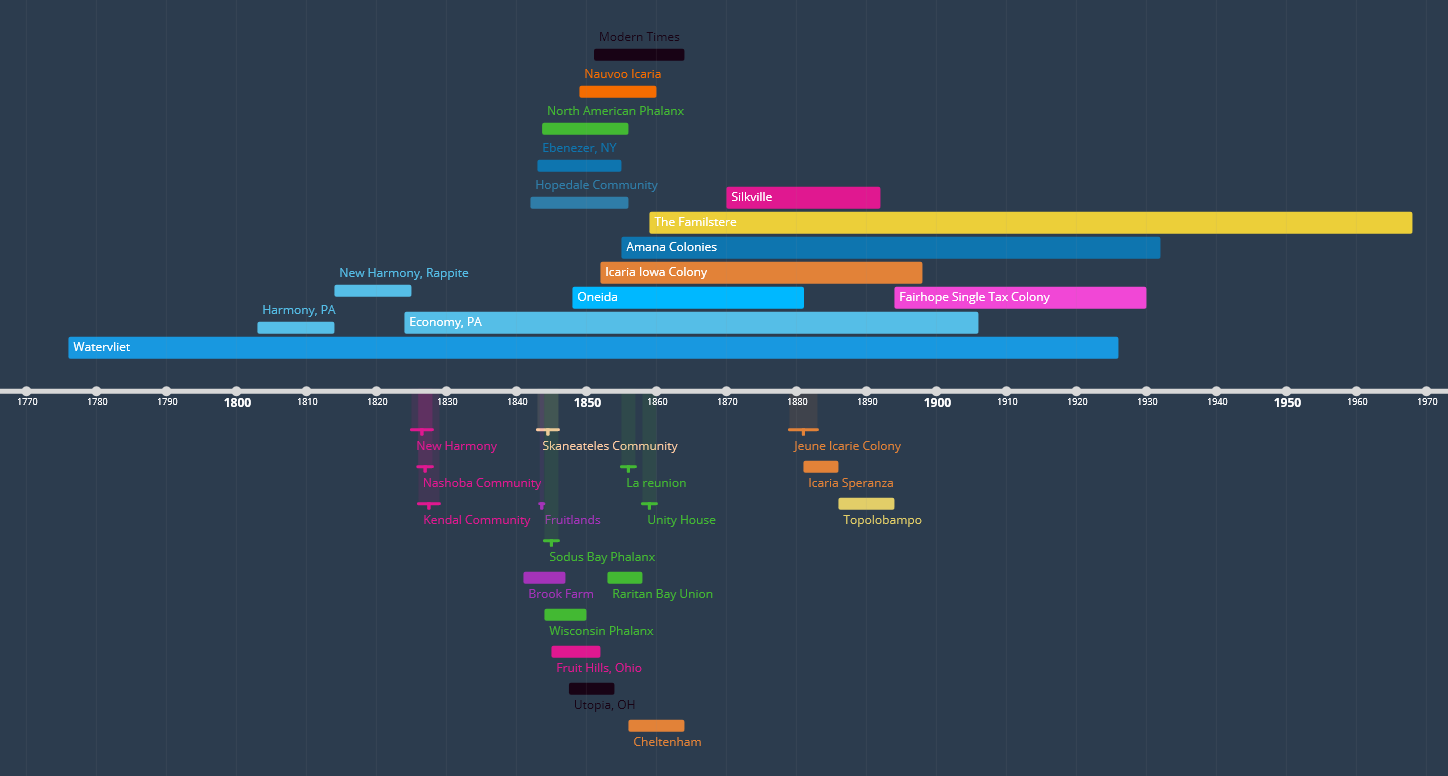
My current research involves not only a whole bunch of short-lived utopian communities spread across ~100 years, but also a ton of not-very-extensively-studied individuals from the same time period.

So, I have a lot of dates to deal with, and a lot of conflicting dates to try to make sense of.

After first trying to learn how to make a graphic timeline on my new Wiki (confusing, and definitely not good for a ton of info), I gave up and went hunting for a free site that would let me visualize (& color code!) the information in a useful way.

ENTER: time.graphics! (who knew .graphics was a TLD/domain ending??)

I'm quite impressed with it so far, particularly as a free site. Being able to see all the communities I'm looking at in this way has been super helpful in understanding the context of everything I'm researching.


I also have a similar timeline with the lives of each person I'm looking at, and I'm starting to build individual timelines for each person as well. It's helped me catch a number of date contradictions from my sources!


There are a lot of features of this particular site that I haven't used, like the integration into Youtube, Google Calendar/Spreadsheet/Analytics/Maps and other things, so I can't really speak to those, but they're there!

That's it, really. I just wanted to share this since I've been finding it so useful!

Saturday, January 20, 2018

My Personal Research Wiki.... IT IS BORN!!~

When I first started on my #homegradschooling journey, I remember coming across an article by a researcher (which for the life of me I can NOT find again), explaining why he loves using a personal wiki for his research, and he linked to his own. I loved the idea, but at the time I couldn't figure out how to use it for my own work.

This week, I realized that with my current research, a Wiki is a perfect way to organize the notes for my current research. So, I set out to build one!

 And it took me A. WHILE. (hours. Miserable, miserable hours!) to figure out how to make one (since I do not currently have webspace to simply host my own via MediaWiki). There was much googling, and much registering for sites that I poked around and now will probably never go back to, such as:

  • Referata (Didn't have the infobox capability I needed)
  • WikiSpaces (ditto above, also only was able to get a free wiki because I'm a teacher)
  • ZohoWiki (Did allow for private wikis, but I don't think infoboxes)
  • wiki-site.com -- I still am not sure if this one is even legit or not. Something seemed fishy for some reason, and I think it also didn't do infoboxes, so I didn't get much past registration.
But in the end, I went with the one I had actually heard of before, but never considered it as a possibility:


I love it because:
  • It allows Infoboxes!
  • It's SO EASY to build infoboxes!
  • It allows templates! Both *for* infoboxes, and for all aspects of each page!
  • It's super easy to cite my sources 
  • Other than the rather excessive pictoral links to other wikis on the bottom of the screen, it's by far the most attractive site of any other wiki I've ever seen.
It is, of course, not perfect.
  • I wish it was easier to cite different pages from the same source without making totally new entries
  • I wish it were easy to put a map into the infoboxes without having to screengrab/find/make a map elsewhere and then just put it in as an image.
  • I wish I could make it private or members-only
But overall, I love it. 

Wiki advertises itself as a fandom wiki host/database, and while it is definitely that, it also invites personal Wikis, too. Best of all, not only does it ACTUALLY ALLOW INFOBOXES--- it has DRAG AND DROP Infobox builders!! I am so very grateful for not having to spend a ton of time trying to learn how to code stuff like that like you do on other wiki platforms. 

So beautiful ;__;

And I am nerding out to an incredible level about this so far. I have never before been so excited to type up notes and quotes! But seeing all this information coming together from all my disparate sources (I still don't know how the heck to organize paper research notes) is kinda thrilling, tbh. Especially since I really am finding so much more information on some of these people than seems to have been found and gathered by a single writer before me. Especially with Marie Stevens Case Howland, it feels like I'm the first person to ever see *all* of her life, and in context before. There's definitely something special about that for history lovers like myself.

I'm not sure if I'll ever show my research on this wiki (though when I'm done I'll definitely be transferring most of the information onto Wikipedia itself), but here, check out the size differences between Marie's Wikipedia page (left) and her barely half-done page on my wiki (right):


BAM. And actually I didn't even have any notes on Marie yet, but I was practicing with my wiki templates and just started working on her because one of my books was open to the chapter on her, and so then I went from there. And I still have managed this much so far, and I'm super excited about how it's turning out. I've been working on some other pages, including those for things I did have some notes on, and they're, obviously, even longer.


I spend so much time reading books and taking notes in pages that end up massively disorganized if not all together lost (ADHD will do that..), that my excitement is probably stemming from the fact that for once, the work I've been doing is VISUALIZED (and this is a big and important thing for ADHDers, for reasons I don't have time to explain atm). Suddenly, especially as an independent researcher, I feel SO much less like I've just been wasting time and accomplishing nothing but reading. I finally feel like the thing which in my head has been my project, can actually be recognized as "A PROJECT!" by others. My boyfriend is a fancy Ph.D. man, and even he is suddenly impressed. Feels good! 

But, I will tell you what. In all of my 30 years, I'm pretty sure that time has NEVER gone faster than it does when I'm excitedly working on this project. "i'm just going to work on this for a couple hour---OH NO HOW IS IT DINNER TIME ALREADY??!?!"

And honestly, that feels pretty good too. :) 

Monday, September 11, 2017


I'm getting back into the swing of my #homegradschool studies (Pre-1930 Female Utopian Writers & Pre-1930 Intentional Communities), and so once again I'm googling tips for how to organize research, since it's been a while.

For the life of me, I could NOT get evernote to let me make a new account & sign in on there yesterday (...I could have used incognito mode on my browser, probably, but I apparently said "meh" to that, and I started a private research wiki instead. I had read a post somewhere about this by a researcher previously, but I have been trying to find it for two days now and just cannot. Sigh. I did find this post though:

How to Build a Paper Research Wiki - Cal Newport

& this:
Gilad Feldman Research Wiki

I'm going to keep looking, though! I need to try to remember all my methods of link saving when I first started this project, maybe I'll find it there!

And yes, this post is 100% written just to make sure I don't lose the above link, too.